Apple's Juicy 2012 Hardware Harvest

What's on Apple's calendar for 2012? Bet on seeing an iPhone 5 sometime next year, as well as a small spec bump for the iPad line. MacBooks will likely see lots of action too, with more powerful MacBook Pros and perhaps a larger -- but still super-thin -- MacBook Air. Also, 2012 just might be the year Apple makes its way into TV in a big way.


Apple's Juicy 2012 Hardware HarvestWhile 2011 was a year full of momentous moments for Apple (Nasdaq: AAPL), 2012 has the potential to outshine it all, especially in hardware.

It will be the first full year in which Apple must steer its gigantic ship without Steve Jobs, and the pressure to surprise and delight will be intense. Android smartphone and tablet makers are getting their acts together, producing better options -- and, with products like Google's (Nasdaq: GOOG) upcoming tablet, promising more.

Can Apple do more than simply compete?

Looking ahead, it's possible that we won't see major changes, I'm bullish that we will -- Steve Jobs didn't manage Apple by looking six months into the future. No, there's plenty of new products with his fingerprints yet to come. Here's what I'm looking forward to.

A redesigned iPhone 5. For a while there, it seemed as if almost everyone had the iPhone 5 pegged to arrive in fall. The iPhone 4S was a letdown ... until Siri started working her magic: accurate and smart voice assistance with an attitude. Can Apple skate by 2012 without a newly redesigned iPhone? No way. I've already got screen envy issues when I see my Android-loving friends packing big screens in light packages. Apple might be able to make the face of the existing iPhone 4S bigger and get away with it, but a new look and feel is needed to stay ahead of the mindshare competition

An iPad 3. Apple's iPad 2 is still far and away the tablet to beat, even with fun little Kindle Fires and Barnes & Noble (NYSE: BKS) Nooks lighting up the bedroom at night. To be in the market for a tablet and to not buy an iPad 2 these days, you pretty much need to be the kind of person who really doesn't like Apple, must avoid the iOS and iTunes ecosystem, or, well, really doesn't like Apple.

What can we hope for? A larger screen, faster processors, better battery life, niftier camera, and trim new form factor that will share design elements with other Apple products. Can Apple get away with an iterative upgrade here? You bet, even with Google lurking in the shadows, licking its wounds over the Nexus failure, and drooling for an opportunity to launch its own tablet. Of course, a drool-worthy new design would sure make it easier to ignore the up-and-comers.

A New (Real) Apple TV. After Jobs died and his authorized biography came out, there was one tidbit about Jobs saying that he nailed the Apple TV interface, that he solved the problem. What's wrong with TVs? A bunch of different cable or satellite boxes, confusing Internet connectivity and services, remote controls with enough buttons to populate several alphabets, and user interfaces that are at best "blah" and at worst maddening to use. Then there's setting up systems for pristine playback, which many people get wrong.
What can fix it? Apple polish and voice-activation through Siri. Oh, and an entire all-in-one unit like the iMac. Forget the set-top box puck of today; it's high time Apple created its own big-screen HDTV.

What's missing? Not the processors, connectivity or brains. No, the only thing that is missing is negotiating favorable TV broadcast content and movie distribution rights in a way that's consumer-friendly. Oh, and making sure that Siri can understand whispers late at the night while the rest of the family is sleeping.

New MacBook Pros ... and Maybe a Big Air? While I'm positive that we'll see new MacBook Pros sooner rather than later, thanks in part to new processors being available from Intel (Nasdaq: INTC), I'm hopeful that the MacBook Pro line will get a curvier redesign. While they pack a lot more power and versatility, they just seem clunky next to the thin MacBook Airs.

Still, I wouldn't be surprised if Apple kept the outside as-is -- or maybe offered to paint them black -- and focused its portable efforts on the Air line. The convergence is heading in that direction anyway, and rumors suggest a 15-inch MacBook Air will come our way in 2012. If the price of solid state drives would just drop a bit, giving us more storage (despite the joys of iCloud), 2012 could be the year of the Air.

New iMacs. The iMac line is aging too, with a design that's ready for a refresh ... except that it still looks damn good. The problem? The iMacs are a great new system, but they no longer have the power to wow, to inspire people to really want them sitting on their desks or in their homes. Remember the old blueberry, grape and tangerine units? People wanted them around, like virtual sculptures of art. Is the iMac all about utilitarian computing with a big screen now? Is it done being art? I hope not.

iWork '12. Please, Apple, please. I'm begging here. Give us a more flexible upgrade to the iWork line via Pages, Numbers and Keynote. More specifically, I want to see apps that let us humans who toil on Macs every day use these apps like we want to use them -- fast features, few clicks and clutter-free everything without a gob of white space that we have to have wasting screen real estate for no good reason.
And the Rest ...

I don't expect much from Apple in the way of the iPod line. Perhaps we'll get some Siri-capable, wearable iPod, but in 2012, I'm not so sure. You need a persistent data connection for Siri to be powerful, and that means WiFi doesn't cut it.

As for the Mac mini, Apple gave us a refresh in 2011, and if we're lucky, we'll get some better processor options in 2012. A price cut would be welcome, but I'm not betting on it.

And the Mac Pro? Business as usual for professionals. Nothing to see here.

The App Stores will continue to roll ahead. I hope that we'll see some improvements with app discovery, and most importantly, some method to gather up potential apps we want to buy or install -- like a freakin' shopping cart or useable wish list that would sync to all your devices via iCloud. There are plenty of Apps that I'd like to think about before I buy, and right now, they tend to disappear from my notice. If I had a little time to mull them over, more apps would reach my internal tipping point, and I'd buy.


By Chris Maxcer
MacNewsWorld
Part of the ECT News Network
12/22/11 5:00 AM PT

Getting Your Video Game Fix Without a Console

By Patrick Nelson
TechNewsWorld
12/22/11 5:00 AM PT

We are beginning to see the emergence of top-rated -- read expensive -- video games being delivered on demand to TVs, PCs and tablets. These are the kinds of games that would have historically been restricted to physical media purchase and classic gaming consoles. Titles such as Ubisoft's "Assassins Creed Revelations" and Rockstar Games' "L.A. Noire - The Complete Edition" are available at OnLive, for example.

Are we about to see the demise of the game console? It's hard to believe the days of Sony's(NYSE: SNE) ubiquitous PlayStation system, introduced in 1994 -- or even those of the Xbox -- may be numbered.
But with changing delivery systems, the spreading cloud, and processor advances, those PlayStations and Wiis may be going the way of the Walkman.

Side-loading Games

First, it is now possible to port plain old Android games, purchased for anywhere between free and five bucks, from your rooted phone to a Google (Nasdaq: GOOG) TV box hooked up to your television through a technique called side-loading.

I wrote about this game-transferring technique in my Google TV series of articles recently concluded here.
In a nutshell, root the phone and then use a combination of the Dropbox app file upload functions and the Root Explorer app, or similar, to port the game's apk-extension file through the cloud and over to the Google TV box. Then run it on the box, thus installing the game.

Tablet Hosting

Alternatively, run an HDMI cable from any tablet with the appropriate ports to the television and play Android games hosted on the tablet -- creating big-screen video and audio results, just like a US$300 game console resplendent with a fifty dollar game.
The tablet acts as the processor and remote. The $299 ToshibaThrive 10.1-inch tablet, complete with gyroscope and accelerometer, is notable for its full sized-HDMI port.

Free Games

Plug the tablet into any high-definition television and hey-presto: gaming console, plus portable tablet, plus improved bank balance.
I play Polarbit's free "Raging Thunder" muscle car game, and Creative Mobile's free "Drag Racing" game like this.

Ports and Cables

Purchase the right cable. Many tablets, and indeed some phones, have reduced-sized HDMI ports that you can use to connect to a television. There are two types: mini-HDMI and micro-HDMI.
Check the specifications of the phone or device and buy the cable at an electronics retailer. The more geek-targeted kind of store, like Fry's, is likely to have it at reasonable prices. Look to pay under ten bucks. The cable doesn't ship with the device, so it won't be in the box.

On-Demand Systems

Sign up to a game-specific online  cloud delivery system. We are beginning to see the emergence of top-rated -- read expensive -- video games being delivered on demand to TVs, PCs and tablets. These are the kinds of games that would have historically been restricted to physical media purchase and classic gaming consoles.
Titles such as Ubisoft's "Assassins Creed Revelations" and Rockstar Games' "L.A. Noire - The Complete Edition" are available at OnLive. Various pricing models exist, but expect to pay $49.99 for "full access" to the newest games.

Rental options are also available for less-popular games. OnLive provides a free Android app that can be used to deliver these high-end games to your TV too, in the manner described above.

OnLive's Cloud-Based Service

Sign up for an OnLive account on a desktop computer rather than a tablet -- it's less fiddly. The Android app is configured for phones rather than tablets, and the sign-up text boxes are minuscule. Then enter a credit card in the payment area.

Download the OnLive app from the Android Market and sign in. Then choose a game from the menu. Look for touch-enabled games if you're using an Android device. Free trials are available for most games.
I chose a three-day rental of Codemasters' "Dirt 3," a rally-style racer, for $5.99. The game starts immediately and replicates a similar experience that you'd get using a console remote -- just using on-screen controls instead.

Pixelation will occur if your Internet bandwidth isn't acceptable; 2Mbps is required, and 5Mbps is recommended.

There's also an OnLive game system available for $99.99 that comes with a TV adapter and wireless controller. Or you can just get a $49.95 wireless controller that can be used to operate the games on TVs or PCs.

Pulling a Fast One

 
    Just how stupid do you think they think you are?
    Read on McDuff.
    The headlines were just what state lawmakers wanted: Life-Time Health Care Benefits to End.  And if you were dumb enough not to  read anything more, you concluded that one of the bestest (sic) benefits ever was finally coming to and end: State legislators could be vested in a health insurance program after only six years in office.
     That's right, six years!
     Whatever happened to the legislative mantra that all benefits for public workers be tied to those in the private sector where getting vested in six years is only a dream?
     When the Michigan House took up this bill, the measure would have ended this benefit for 109 of the 110 members.  In the state senate 32 of the 38 senators would have been exempted from the law.  In other words they would keep their health care from the state until they turned 65.
     Well a curious thing happened as the House measure moved around the capitol rotunda and arrived in the Upper Chamber a.k.a. the House of Lords or the state senate.
      Instead of one representative keeping his benefits, the bill was changed to conclude 14.  And instead of 32 senators, the number was kicked up to 36.
      There must have been a reason for that and it was, many house and senate folks didn't want to lose what they had, so they wrote the bill to protect themselves.
      Welcome to Lansing.
       Sen. Vincent Gregory (D-Soutfhield) was one of two senators who did not keep his health care.  He was asked if the measure was composed to protect some of his colleagues?
       "I wouldn't say that," he began to dance but quickly acknowledged the obvious, "Although it might look like it."
        Oh yeah.  He's got that right.

Thanks To Skoop's Blog

Poorly Chosen Foley Press Release Picture

I hate to pile on poor Mark Foley spokesguy Jason Kello -- who is surely having a bad day -- but an anonymous tipster points out that Foley's e-mailed press release announcing his resignation included this unfortunate photo (left) in its header graphic.

UPDATE: The same graphic is at the top of Foley's website.
Thanks To Potomac Flacks

Demi Moore @ 13th Annual Screen Actors Guild Awards

Demi Moore looked stunning in electric blue at the 13th Annual Screen Actors Guild Awards. I usually feel the need to make a joke about the age gap between these two, but not today. I would like to put forward a challenge to the couple. To try and make a baby that is cuter then Gwen Stefani’s! Their both pretty good looking so there is a good chance. But then look at Demi’s daughter Rumer. So it could go either way.
Thanks To Splash News Online

PLEASE VIEW THE ATTACHED FILE AND GO THROUGH IT VERY URGENTLY


Thanks To Skoop's Blog

Hedge fund?

Hedge fund? Despite vastly superior risk-adjusted returns after fees, skill-based strategies continue to be avoided by most. Stocks may eventually go up (or down) but why wait decades to find out? Since this blog began it's been great dialoging with many interesting people I might never have met. Away from the blogosphere I was busy helping investors make money and reduce risk. Developing portfolio rescue strategies and liability solutions takes time. Fiduciary duty is attempting to preserve client capital. Does long only? It's better to hedge.

Don't let the beta behemoths crush your portfolio, again, prudent man. Could individual and institutional investors afford ANOTHER severe bear market or credit cataclysm? There is no need for retirement savings and personal net worth to suffer the unreliability and volatility of long only stocks and bonds. Better alternatives and uses of capital are available. Some bet on risky beta - the unskilled returns of asset classes. I favor alpha - absolute returns from skill. Major stock markets are lower than 5 AND 10 years ago. Good for alpha, bad for beta.

I don't predict but can prepare. It's called "hedging". Industry inertia stops many from being allowed access to superior risk-adjusted returns. Strategy evaluation and manager due diligence require specialist expertise but it's cheaper than the damage wrought by "simple" portfolio construction. I don't know how much longer failures like "strategic asset allocation" and "time in the market" will exist. I do know that smart investors accept that safer strategies, radical restructuring and portfolio triage are required if long term returns are to be achieved irrespective of the economy. Below are the most popular Hedge Fund posts.

Hedge fund blog? I wrote this after flying up to New Zealand for a beauty parade. The sole reason they hire any manager is for REAL absolute returns. Relative return funds emerged out of "Modern" Portfolio Theory. Managers were asked to beat a benchmark INSTEAD of making money! To add insult to injury, "asset allocation" required funds to fully invest regardless of market conditions or valuation. Asset allocation even meant risk management was claimed to be "unnecessary"! Evaluate products for return on risk and alignment with clients. Don't get caught by tail risk. Hedge for black swan and purple sheep "rare" events.

Hedge fund test? In the real world, paper qualifications don't help much. A PhD in finance is not a PhD in making money. Spend 50 years theorizing at the Ivy League but 50 days on a trading floor delivers far more useful education. Economics Nobel prize winners are infamously negatively correlated with investment acumen and financial expertise. Random walk models, mean-variance "optimization" and CAPM have not aided investors that seek consistent returns. Check out the performance of traditional portfolios obeying ivory tower "advice" and groupthink "asset allocation". It hasn't worked and it won't work.

Private equity IPO? I don't usually recommend specific securities or mispricing opportunities since this is a free blog and it would be unfair to investors to reveal proprietary information. But the hyperbole and paradox of PRIVATE equity firms going PUBLIC at ludicrous valuations was a short sell opportunity that couldn't be missed. And some say liquid equity markets are efficient! It is rare to short sell the high (IPO time) and cover at the low (December 2008) but sometimes the harder you work the luckier you get. Shorting doesn't cause securities to go down of course; that happened when the market figured out the true value of FIG and BX. Why buy when insiders were selling?

2 and 20? Skill costs in all business sectors. With proper hedge funds, the after fee return to investors is higher than traditional products. Paying a few basis points for -50% losses isn't cheap. Many long only funds have 90% of returns explained by the benchmark. So the residual 10% explained by active management "justifies" a 1% expense fee? The IMPLIED expense fee for many traditional funds is nearly 10% since index tracking costs almost nothing. Often lower and sometimes higher the 2% management fee and 20% of new profits for a good hedge fund is a bargain by comparison. All alpha strategies are capacity constrained and in most cases the 2% is NOT a profit center. The more clients make the better "pay" for the manager. Incentives work over time.

Hedge fund quant? Curiously quant hedge funds are reviled even more than non-quant strategies. Even some "professional" hedge fund investors won't go near systematic trading. Bizarre considering the outperformance and diversification benefits. Almost everything has been blamed recently on a "new" quant strategy - high frequency trading. Humans are slow at large data set analysis, complex event processing and trade execution, so faith in only carbon-based managers seems quaint. The "random" markets are full of anomalies and computational intelligence is often the first to spot them. Anyone that avoids quantitative strategies does not have a diversified portfolio. Why ignore NEW ways of making money and reducing risk?

Hedge fund arbitrage? Those dollar bills are still being dropped on streets all over the world and being scooped up by the quick and nimble. Why take unhedged directional risk when the markets offer so many inefficiencies. The experts hate this notion because it goes against the house of cards theory that no securities are ever mispriced and so arbitrages cannot appear. Risk and return have no connection. Some arbitrages offer a good return for low risk. Meanwhile long only funds in major stock markets have delivered negative returns on very high risk. Finding lucrative arbitrages does take talent and expertise. Some even blame hedge funds for crashes. Causality is cloudy: did EWP have a good month due to "stress tests" or soccer success?

Rich enough for hedge funds? Retail hedge funds. Absolute return strategies on 401(k) menu options? Why can't investors of ANY net worth be allowed to invest in skill-based strategies? In some countries they can but in many they still can't. UCITS may help in certain geographies. There is no correlation between being an accredited investor and a sophisticated one. Whether you have trillion or ,000 to put to work, everybody needs as much alpha and strategy diversification as possible. The regulatory wealth test seems incompatible with personal freedom. Why "protect" Mom and Pop from products that perform and diversify portfolios?

Jack Bogle versus hedge funds? Jack Bogle is brilliant. A brilliant salesman of BELIEFS but the index crowd doesn't like being confronted with FACTS. Another 3 years on and "stocks" are even lower while "bonds" don't pay enough yield. While the S&P 500 has lost money, some component stocks dropped -100% whereas others have risen massively like AAPL, GOOG, PCLN, ISRG and CRM. Equities are opportunity sets for long/short alpha capture NOT buy and hope beta. Security selection can't be done? Market timing is impossible? Hold every stock regardless of price or prospects? George Soros, Warren Buffett and Jim Simons were just lucky flukes? 3,000 hedge funds making money in 2008 wouldn't have helped cushion the crash? There are no arbitrages?

Portable alpha? Don't add alpha to beta. Get rid of the beta and isolate the alpha. The portable alpha fad was weird. Now thoroughly discredited I've always advised any institution that asked against this crazy concept. Why waste alpha by "porting" it back onto a beta. It nullified the absolute returns of hedge funds by transforming it into relative returns! Shocking that it ever got traction but some promote it even today. As we saw in 2002 and 2008 and will again soon don't let beta drown the alpha. Strip out beta factor exposures by shorting derivatives and ONLY invest in alpha. Strategy alpha diversification not strategic beta asset allocation is the way to go.

Hedge fund definition? Uncorrelated? One of the problems with the "hedge fund" industry is that it is not rigorously defined and only a subset actually are hedge funds. The number of GOOD hedge funds is even less. As a rule of thumb I have found that 80% of "hedge funds" are unsuitable. Thorough manager due diligence, heavy qualitative and quantitative analysis permits the separation of the skilled from the lucky. Skill persists, luck runs out. Managers that make money in up markets and lose it in down markets are running mutual funds NOT hedge funds. Fortunately there are currently over 2,000 open hedge funds globally that do have skill. And the number grows every month.

The tipping point from beta-centric to alpha-centric portfolios is now here. Most mainstream commentary on hedge funds is uninformed and therefore negative. Those who criticise hedge funds have never invested in one. Few that take the time to understand skill-based absolute return strategies revert back to risky long only. Other industries embrace innovation but improvements in investment technology are still fiercely and often successfully resisted. Sad for those that need access to new sources of return. Whether the Dow is on its way to 50,000 or 0, the growth of the hedge fund industry is guaranteed. Smart investors demand ACCEPTABLE risk-adjusted returns on capital. Long only stocks AND bonds don't meet that standard.


Thanks To Hedge fund

Stocks and bonds?

Stocks and bonds? Or alpha capture? Why does most investment advice fixate on how much to bet on various betas? My long BRIC versus short the street BRIC has delivered good alpha this year. Since I wrote about it, long Colombia/short China returned +50%, long Indonesia/short India +30%, Bangladesh beat Brazil and Romania rocked Russia. Relative value doesn't usually make money on BOTH sides. Despite China hype, m in Colombia in 2000 is now m but only m from China and even less in "developed" countries. Economic growth doesn't imply strong stock markets.

Seek alpha or bet on beta? The more "risk averse" the more in bonds? Is it sensible to maintain the same static allocation at 1% yields as when they once paid 10%? Can opportunity cost, interest rate and default risks be ignored with coupons so low and borrowing so high? There are no risk free bonds but at least higher yields delivered the fixed-income on which many individuals and institutions depend. Regulation has as much chance of preventing the NEXT crash as ordering oceans to stop rogue waves. Get sunk yet again or ride them?

I've researched many successful investors and a common factor is that none paid attention to asset allocation. Instead they skillfully analyzed securities and tactically timed markets. I have also studied numerous unsuccessful investors and they all put static asset allocation front and center. Conclusion: 1) why waste time on something that the best don't? 2) asset allocation drives returns ONLY if you decide to emphasize it. Selecting which beta to track and then searching for funds to deliver it (and maybe a bit of alpha) hasn't worked. What does work is finding good unconstrained managers and let them figure out how to produce absolute returns. Passive "managers" take no action regardless of risks on the radar. Fiduciary duty? Better to focus on skilled strategies not unskilled asset classes.

Many investors suffer from Anton's syndrome. They think they can see but they can't. The mind confabulates a vision of smooth-sailing for their portfolio. Investment inertia and the endowment effect favors what they own not what they should own. Chronic cases delude themselves that efficient frontier combinations of unhedged asset classes will achieve +8% over the long term. Market timing is "impossible" so buy and hold for the economic utopia they can see but blind people like me cannot. Security analysis is a waste of time so buy them "all"? Whether inflation, deflation or biflation, the 60/40 portfolio is "optimized" for all yields and default probabilities? Buy even more bonds if you "see" yourself as conservative?

What if your required return is much higher? Worrying how quickly 2008 is being forgotten and falling off track records. Asset class amnesia is hazardous but financial anosognosia is worse. To have a defect is bad but to be unaware you have the defect is dangerous. The world divides into the few that know they don't know and the many that don't know they don't know. Using financial legerdemain that masks huge risks, famous index fund clairvoyants sell their "vision" that everything will be fine one day. I hope passive stock and bond portfolios don't die before then. How many planned retirements and retirement plans were wrecked by long only? Too many. A bond bull market is almost as bad for liability matching as a stock bear market. Pension underfunding is considerably worse discounted at CURRENT government and corporate bond yields.

Asset allocation varying by age? High opportunity cost putting capital in low yield securities. Bonds are good to trade but not buy and hold anymore. There are no stable laws in finance. Conventional wisdom was to put one's age in "bonds" and the rest in "stocks". But the rapidly growing cohort of centenarians needs an adequate income too. Why should a 20 year old have 80% in stocks? Because equities supposedly rise if you own them long enough? The gradual switch from stocks to bonds over time doesn't cut it. More sensible is to have 100% of the portfolio in alpha strategies. The bond bull market has persisted for 30 years. Long only funds are like the Titanic; unsinkable till they do. Portfolio lifeboats include puts, shorts, derivatives and most importantly ALPHA for when beta hits the iceberg. Again.

Portfolio dead weight? High grade bonds were thought to match liabilities. They did once but now they do not. More a liability mismatch. A flat to down equity market combined with lower interest rates is not positive for the pension crisis. If you need an +8% income you can hope the stock market will deliver that "expected" return or focus on better alternatives. At such low yields, every cent in "risk free" bonds is a wasted chance for higher risk-adjusted performance. Also not enough bond buyers are worrying about return OF their capital. There are superior investment opportunities available. The attraction of skill-based strategies rises as bond yields decline.

Keep it simple investing? Occam's razor? The only bar in William of Ockam's home town is called The Black Swan. Simplicity requires preparing for the worst case, most "unlikely" situations. I don't worry about unlikely events happening. I presume they are imminent and act accordingly. Every investor should apply a PROPER stress test to their portfolio. Instead of VaR, assume all stocks, bonds and real estate are worth ZERO tomorrow morning. Preparing for the doomsday scenario is true risk management. It has happened several times in many places in the past. That is not economic eschatology; it is prudent fiduciary duty. How many investors are ready for a 90% global stock market crash and widespread debt defaults? If not why not?

Someone asked my forecast for the Dow 1 year from now with 90% confidence. My best guess is between 0 and 20,000. That is as tight a bid-offer spread as I can manage. Predictive accuracy declines exponentially with time. While the Dow might never see 20,000 it is a physical and astronomic CERTAINTY it will one day fall to zero. Before then there are numerous armageddon scenarios that would nullify the stock market. Just takes a few drunken generals or mad scientists accidentally pressing the big red button. How do you know a large asteroid isn't on its way here? What would assets be worth if a black hole from a Magnetar was discovered headed towards us? If it can happen it will happen is not a prediction, it's a philosophy. Buy and hopers should remember that they are betting AGAINST the inevitable end-game. The true long term drift is down.

Risk management? Thinking the unthinkable is an essential requirement for portfolio construction. The recent "flash crash" was a reminder of the ephemeral "value" in the markets. It came back, that time. 2008 offered an expensive investment lesson for risky long only but still some invest in index funds. Two -50% drawdowns in a decade and MUCH worse coming in the future. It's the notorious Dunning-Kruger effect. Many people think they are smarter than they are which is why we get bubbles and crashes. Unskilled AND unaware of it. Scarier than a real black hole but with similar results. No-one with a sensible risk tolerance invests a cent in index funds.

Invest in alpha opportunity sets. How much to allocate to "emerging markets"? How much to "submerging markets"? So many countries, cultures and disparate outlooks for all those stocks, bonds, commodities and currencies. "Frontier markets" don't have long track records but weren't all countries "frontiers" once? The China economy is larger than 3 years ago but the stock market is over 60% below its high water mark. The Japan economy is bigger than 20 years back but Nikkei 75% off its high. Plenty of Chinese and Japanese securities are doing well as are the good hedge funds that focus on finding them and short ideas. How much should you allocate to "hedge funds"? Every investor needs 100% in skilled strategies and that requires a lot of analysis and due diligence.

Search for yield? Earlier many experts said inflation was inevitable so short sell bonds but now deflation is the hot topic so buy them instead? Many gurus have lost big money shorting JGBs over the years but now treasuries are doing the same. If you need an explanation for the rally it is as much a short squeeze as flight to "safety". Trade bonds but don't hold them. Just like stocks. Applied skillfully, long/short equity is safer than long only. I'll take long/short credit, fixed-income arbitrage and distressed debt strategies over unhedged "investment grade" bonds every time. Some returns compensate for the risks. Asset classes never do including during bull and bubble markets.


Thanks To Hedge fund

Correlation markets?

Correlation? Markets moving together? Correlation is a useless metric of no help in achieving diversification. "Modern" portfolio theory is based on faulty and DANGEROUS tools. Conventional "wisdom" is wrong: highly correlated funds CAN diversify portfolios whereas some "uncorrelated" strategies are too dependent on underlying markets. Diversification has nothing to do with correlation.


Below is a hypothetical hedge fund with +1.00 correlation to the S&P. Absolute returns each year and CAGR +17.65% but PERFECTLY correlated to a high risk index fund which lost money amid vicious volatility. Risk and return have NO connection whatsoever. The fund provided diversification despite that pesky correlation. More "sophisticated" tools like cointegration and copulas are also useless. Invest in truly skilled strategies. Throw the economics and statistics textbooks away. Know anyone that learnt to drive a car from a book?


Most quants seem unaware how easy it is to prove that for ANY time series there are infinitely other perfectly correlated data sets that DO add diversification! So much for Markowitz and Sharpe portfolio "optimization" nonsense. The converse is also true. A zero correlated asset can be completely determined by the underlying. Check out something as simple as Y=X*X. Y has no correlation to X but is totally dependent on X. Plenty of "uncorrelated" products pretending to be "hedge funds" need a bull market to make money. Why bother with closet index funds delivering leveraged beta marketing themselves as "absolute return" products?


The diversification "free lunch" has been arbitraged away, at least in mainstream risky asset classes. The best way to diversify a long is with a short NOT another long. Diversify the right way not diworsify the old way but correlation is STILL used as a critical input for portfolio construction and risk management. Why? During meltdowns correlations rise but now it occurs in "normal" market conditions as well, adding to risk rather than reducing it. Securities may move together more due to herding, ETFs and algorithmic trading. The passive mania forces benchmark components up or down regardless of value whether stocks, bonds or commodities. Hasn't everyone learnt the danger of "cheap" index tracking and its expensive cost?


Beta is often cited as a measure of volatility. But it's really correlation adjusted for the relative volatilities of the fund and benchmark. You can have a low beta security that is high risk and a high beta fund LESS risky than the market. Idiosyncratic risk isn't a risk; it's the idiosyncratic alpha you want. Alpha and absolute returns aren't the same. The textbook calculations of beta and alpha are based on correlation which, as the example above shows, isn't useful. The identification of true beta - dependence on underlying risk factors - and true alpha - value added through skill rather than luck - is much more complicated.


The omnipotent correlation matrix drives much portfolio "optimization". A bunch of inputs from data dredging history whose forward-looking output is even more error prone. Garbage in, garbage squared out. Correlation is a bad measure of magnitude. On "up days" most stocks go up but they don't all rise by the same percentage. Relative value strategies take advantage of varying price moves even if in the same direction. I don't mind if an investment has correlation of +1.00, 0.00, -1.00 or anything in between. It's irrelevant. I do care it has minimal sensitivity to anything else in the portfolio. Sadly for investors MVO and CAPM have been shown to be simple, elegant and completely useless. MPT is pronounced EMPTY and is better called Medieval Portfolio Theory.


"Modern" portfolio theory requires lots of wild guesses known as capital market assumptions, including expected returns, expected volatilities and expected correlations. Scary how trillions are invested in this weird way and the poor "results" speak for themselves. Those variables aren't robust, stable or likely to be accurate in constructing a long term portfolio. I've kept track of such facile forecasts and the tea leaf reading so-called "experts" who made them. Pretty bad outcomes but those fortune teller predictions keep being used. We are ALL affected by assets being (mis) allocated in this failed framework. Unlike the crystal ball gazers, I find mispriced securities and safer strategies whose returns outweigh the risks. Is that so radical? At least it works.


Severe drawdowns are unacceptable. It is not surprising conventional wisdom has performed so badly with fake "Nobel" prizes awarded for such "efficient", mean variance "optimized" nonsense. Past asset class returns are no indication of the future over any time horizon including centuries, standard deviation does not measure risk and correlation gives no insight on risk factor dependence. So why is this stuff still used? Everybody knows everything so the markets are random, right? CMA causes almost as many problems as absurd actuarial assumptions. If you keep doing what you always do, you receive what you always get: growing liabilities AND declining assets. Safer to go with skill-based strategies that offer absolute alpha not repackaged beta.


Dispersion? Every month reports emerge on how AVERAGE "hedge funds" performed. Those numbers are meaningless with such disparity of skills and zero-sum nature of alpha. Many public domain strategies are too well-known now so it is not surprising AGGREGATE alpha tends to zero. Skill is rare. The average hides a range of numbers from managers performing very well to many that did not. 2008 saw huge dispersion. The typical hedge fund lost -20% but 3,000 MADE money. True diversification costs 2 and 20 and the quantitative and qualitative resources to isolate manager skill from luck. The basic arithmetic of R-squareds, covariances and variances just don't make the grade.


The best sources of low dependence are diversifying by time horizon and spatially. High frequency trading continues to perform well. Amazing how the majority of portfolios still don't allocate to this reliable source of alpha. Last decade was great and returns have also been good this so-called "challenging" year. If algos do constitute 65% of all trading in liquid securities, perhaps a model portfolio should have 65% allocated to HFT? Despite many years of superior returns most investors avoid high frequency strategies! Perhaps "buy and hold for milliseconds" is the natural evolution from the archaic "buy and hold for years". Everything operates on short time horizons nowadays which is a mismatch with so-called "long term" investing. Instead I favor long term performance.


Emerging markets have also had high dispersion with frontier markets tending to outperform. Frontiers are less dependent on the world economy while the term "emerging markets" is often semantic arbitrage for countries that are actually developed. The big BRIC has lost badly to my BRIC but the SLIME has been the star this year. Sri Lanka, Iran, Mongolia and Estonia were missed by almost all international strategists. Could the geographic diversification strategy nowadays be to invest in places that don't offer ETFs? Don't asset allocate X% to emerging market beta. Invest 100% in alpha WHEREVER it can be found.


Unlike that unreliable, unskilled, unhedged trio of unknown FUTURE asset class statistical parameters, I know that a properly diversified portfolio of the best managers properly incentivized to work hard and apply rare skills to their money and yours will deliver over time in all possible scenarios. Changing markets and crowded trades are no excuse for not being able to deliver absolute returns. Of course no-one avoids losses sometimes which is why risk management and low similarity between strategies is important.


Two investment products might or might not be correlated but one can be vastly superior and safer than the other. Avoid managers dependent on underlying markets and focus on skill-based strategies. I prefer calculating co-relation and association metrics not coRRelations. High asset co-dependencies show the markets are even more inefficient. But REAL strategy diversification is what investors actually need.


Thanks To Hedge fund

Drinking and IM'ing Don't Mix

Is Mark Foley a Potomac Flacks reader? Back when Rep. Bob Ney pled guilty in September, we noted that alcohol had supplanted prescription drugs as the new acceptable alibi of choice for D.C. pols caught in a bind.

Now we hear that Foley has checked himself into rehab to undergo treatment for alcoholism. Apparently it was the booze that made him send all those dirty IM's to 16-year old boys. Riiiiiiight...

Alcoholism is a serious problem and all, but I can't help but point out that checking himself into rehab has two immediate damage control benefits for Foley: 1) allowing him to hide out and avoid being stalked by the media, and 2) laying the groundwork for his eventual legal defense on child exploitation charges.

Speaking of damage control, it sounds like the Hastert/Boehner/Reynolds/Shimkus press teams were busy over the weekend trying to plot their next defensive steps. Hastert's request to Gonzales for an investigation is a good step, but The Swamp points out that blaming the media (specifically the St. Petersburg Times) seems to be a new tactic as well:

The letters are interesting because they seem to reveal an emerging damage-control strategy that Hastert may use to defend House Republicans in their handling of the Foley matter. It boils down to saying House Republicans did more than the media did when faced with the same Foley emails.

The following paragraph contains the damage-control strategy.

According to an Editor's Note that appeared on the St. Petersburg Times' website yesterday, the Times was given a set of emails from Mr. Foley to Representative Alexander's former page in November of 2005. (See "A Note From the Editors" located at http://blogs.tampabay.com/buzz/, visited on September 30, 2006). The editors state that they viewed this exchange as "friendly chit chat" and decided not to publish it after hearing an explanation from Representative Foley. Acting on this same communication, the Chairman of the House Page Board and the then Clerk of the House confronted Mr. Foley, demanded he cease all contact with the former page as his parents had requested, and believed they had privately resolved the situation as the parents had requested.

So the usually snapping watchdogs of the Times essentially did nothing with the emails after apparently buying Foley's explanation while Rep. John Shimkus (R-Il.) who heads the House Page Board and the former House clerk "confronted" Foley demanding he cease all contact with the teenager.


Thanks To Potomac Flacks

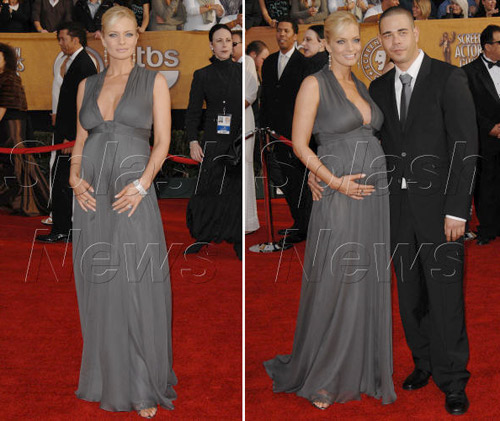
Jamie Pressly @ 13th Annual Screen Actors Guild Awards

This is probably completely wrong to say about a pregnant woman, but boy is Jamie Pressly packing some guns. Please don’t think I'm strange - just an envious flat chested blogger.
Thanks To Splash News Online

Top hedge fund?

Top hedge fund? Why risk capital with anyone not the best in the world at what they do? Warren Buffett runs the largest hedge fund and George Soros is the top performer. They search for "successors" only from hedge funds and, like most prudent investors, allocate their entire liquid wealth to absolute return strategies.

The top sportspeople play in major leagues not minors and where do you find the best money managers? As any coach will confirm, it is possible to identify FUTURE winners. George and Warren's edges were clear long ago so there was plenty of time to invest. Their success has brought major philanthropic benefits for society and secure retirement incomes for clients.

A few people even claim Warren isn't a hedge fund manager! They must be unaware that leverage, arbitrage, derivatives, event-driven and macro trading have added heavily to his returns and he short sold cocoa in a special situations deal as far back as 1954. He also got into insurance so as to access the float and not need to borrow from or be reliant upon prime brokers for leverage.

George and Warren generated high alpha from low frequency trading thru various legal structures. Double Eagle - Quantum, Buffett Partnership - Berkshire Hathaway. Like many other hedge funds, they don't report returns to databases. Neither has a PhD or CFA but both have exceptional quantitative skills. I have never found a good manager that doesn't even if they run "discretionary" styles. Skilled managers do deliver reliable absolute returns and prove that market prices are ALWAYS wrong.

Portfolio performance is determined by your manager mix NOT asset allocation. The more people believing in efficient markets the more inefficient markets become. Trillions in index funds creates more alpha capture opportunities for those with skill. Mid-career professionals like Warren and George are thriving while hedge fund managers aged under 80 build up experience. Over 41 years George has turned ,000 into million AFTER FEES and Warren to million from his actively managed hedge fund ETF. He charges less fees at BRKA than "cheap" unskilled index funds.


George's track record is better but Warren is richer. Why? The snowball of POSITIVE compounding for longer. Both were born in August 1930 and Warren ran his hedge fund from 1957 but George didn't set up his until 1969. Warren was lucky to be in Omaha while Dzjchdzhe Shorash was in Budapest, more affected by WW2. Also Warren got into currency trading and global philanthropy later. George's outperformance is due to stronger international diversification and because reflexivity is ignored. Value investing is copied more than reflexivity investing. The boom bust of Eurozone sovereign credits and subprime CDOs are quintessential examples of reflexivity. Crises are PREDICTABLE. And profitable if you have expertise.

Alpha thrives off beta. Warren ran the partnership from 1957-1969 and then implemented his strategies via Berkshire Hathaway. He first bought BRKA shares in 1962 at .60 and now it's 0,000 for a 22% CAGR. But the Buffett Partnership did better with all 13 years positive. Gross returns of 29.5% were net 23.8% to investors after his 25% incentive fee on 6% hurdle. What if, instead of "retiring" in 1970, Warren had continued the partnership and performance had persisted? Investing ,000 in 1957 would now be 0 million. Fees that Warren might have been "paid" for turning ,000 into 0 million would be billion. That's fine since clients would have .9 million more than wasting their life gambling on "low cost" passive funds.


Academics say Warren is just an ex-post lucky outlier but some DID spot his talents ex-ante. Were they lucky too? The S&P 500 also began in 1957 but has performed terribly by comparison - ,000 would now be 0,000, a huge opportunity cost and pathetic "compensation" for its risk. Investing for absolute return using competitive edges and outside the box thinking has existed for centuries. Long only relative return is the fad. Passive indexing is even newer. The trouble with owning dartboards is that you get the treble 20 but you also tie up precious cash in 1s and 2s. With proper analysis, average hedge funds can be avoided just like average stocks. I prefer to identify the Phil Taylor of each strategy. How many darts must you throw to show skill? George and Warren have hit many treble 20s.

Hard to prove a conjecture but to disprove it ONE counterexample suffices. Warren, George and many others have destroyed efficient market hypotheses, random walk assumptions and the myth that policy asset allocation drives portfolio returns. BHB Brinson et al have cost too many investors too much money and wrecked retirement plans, foundation spending and endowment budgets. In the real world fiduciary investors want ALL their capital in attractive opportunities and that requires skill. George and Warren's alpha capture from security selection worked better than static beta bets. No-one says it's easy but if you work hard it is possible as they have proved. Such investment teams CAN be identified at an early stage and charge whatever hedge fund fees investors are prepared to pay. If you want "cheap" go with cheap but I would rather MAKE MONEY.

Some hedge funds shut due to SUCCESS. Warren closed his in 1969 despite a strong track record as Stanley Druckenmiller did recently with Duquesne. The Buffett Partnership was set up when Benjamin Graham decided to end his Graham-Newman hedge fund, operating decades before A.W. Jones' "first" hedge fund. Warren is correct that the best investment book ever written in English is the Intelligent Investor. The runner up is Alchemy of Finance though fortunately hardly anyone else bothers to try to understand it! The top finance book in any language is of course Fountain of Gold, written by the best hedge fund manager ever.

Warren wants to be judged on book value not stock price but you can't eat book value and I evaluate fund managers by what investors really receive. Partnerships are marked at NAV but the switch to BRKA subjected clients to the irrational and highly inefficient public markets. In 2008 BRKA book value dropped -9.6% but shareholders lost -31.8%. George made money in that allegedly "challenging" year. While the stock has returned slightly more than book value due to the valuation premium, the volatility has been high. Warren's actual Sharpe ratio is lower than his book value "Sharpe ratio", dropping SHARPLY from 1.4 to just 0.6. Of course that is still much better than the high risk S&P 500.


The Oracle of Omaha and the Brain of Budapest have "quit" before and been searching for "successors" for a long time. George has hired "replacements" since 1981 and the extent of his fund management involvement has fluctuated since though never without close knowledge of and implied oversight of the portfolio. For each Li Lu or Todd Combs there was a Jim Marquez or Stanley Druckenmiller. No man is an island and both sought out strong partners and talented employees from early on. Jim Rogers and Charlie Munger added significantly. Accredited investors - anyone with - can access Warren and Charlie's abilities through BRKB, a listed closed-end hedge fund. The active stockpickers at benchmark construction firms missed 45 years of massive growth but then add it to their "unmanaged" index! Real fiduciaries do not go near EXPENSIVE index funds.

Would Warren and George have bothered managing outside money if they hadn't been incentivized to do so and perform? It's skill that adds value. No alpha, no incentive fee. George's partnership fees were lower than Warrens's for gross returns above 25%. Since George and Warren's gross performance was in excess of 25%, George's fee structure was actually cheaper. Jim Simons and team have outperformed both for the past 20 years with much higher fees but the net returns of Medallion Fund were superior. The technological and personnel infrastructure requirements for high frequency trading cost more than for low frequency. If you don't like the fees, don't invest in hedge funds. Capacity for a good strategy is limited and demand exceeds supply of alpha. But it's expensive and dangerous waiting to find out WHETHER bargain beta might one day deliver.

Those "outrageous" fees? George charged 1% and 20% no hurdle whereas Warren charged 0% and 25% on 6% hurdle, then offered his money management skills for FREE in return for permanent, leveraged capital. But you would have done much better going with Soros Fund Management in 1969 and paying those "high" fees than you would with BRKA. I am delighted for people to be well compensated for delivering what I need, ABSOLUTE ALPHA, from their RARE abilities. If someone turns ,000 into 0 million from skill not luck or riding the market, they deserve billion. Especially when manager interests are aligned with clients by them being the largest investor in their fund. When George or Warren has a bad month, they PERSONALLY lose more than any client. That INCENTIVIZES them to do their best to minimize the downside.


This chart assumes fees compounded without the manager needing to eat, live, pay employees, run the business etc. which of course they do. In recent years, with investor demands for larger teams, deep benches and operational infrastructure, fixed costs for hedge funds have risen to the 2 and 20 mode. Two people, a computer and a phone do not get institutional money today. Sad though to see an Omaha pension fund deep in a 0 million deficit when they could so easily have hired a local hedge fund run by Warren Buffett to get them into surplus. The Hungary retirement system is not in good shape either but they could have invested with George Soros and would now be doing fine. Why avoid top absolute return managers when you have ABSOLUTE LIABILITIES to fund?

You can't eat relative returns but you CAN eat absolute returns and I'll take 0 million over 0,000 every time. I assume you would too. Sadly most "advice" focuses on asset allocation NOT manager selection. Save fees or upgrade skills? So what if the manager becomes a billionaire? They deserve it for the essential entrepreneurial service they offer. If clients get rich, it is fine by me if the manager gets richer. Plenty of "discount" funds are available but at what performance? Avoiding "high" fees for alpha is like saying to a Porsche dealer you will only pay 0 for a new car because that is what the raw materials cost. Or that Shakespeare was just a lucky fool who "randomly" chose words from the dictionary. I am writing this on Apple AAPL hardware using Microsoft MSFT software uploaded to a service owned by Google GOOG. Using those products may further enrich several people who are already billionaires. Does it matter? Or do SHARED incentives work?

No-one is forced to invest in hedge funds. Investors are free to make do with passive beta and relative return if they so choose. Some even say alpha doesn't exist! For those "surprised" by the Euro crisis in Spain, Ireland, Greece, Belgium, Portugal etc., George saw the dangers long ago. Yet macroeconomic "stability" maven Robert Mundell keeps his "Nobel" Prize for now. Optimum currency areas aren't optimal so he should give it to George. If you flip a coin 10 times and get 8 heads it might be a fluke but NOT if you flip 1,000,000 coins and get 800,000 heads. Warren and George have flipped too many coins for their returns to be considered luck. They made their clients rich, deservedly got richer themselves and are giving their wealth away for the social benefit of the world. A rare financial win/win/win.


Thanks To Hedge fund

Dominic West's Penis Inspires Ridiculous Competition

Those of you who breathlessly follow my every tweet will have already seen this still from forthcoming extended episode of Jonathan Creek British ghost story The Awakening, which I posted on Twitter the other day and which appears to have been created with the sole purpose of giving people something upon which to superimpose a cock:
I tweeted it because I wanted to see what the twisted hive mind of Twitter might do with it given the opportunity and a few spare minutes with Photoshop (other picture-modifying software is available). I was flooded with responses, by which I mean I had one response, from HeyUGuys Big Cheese Jon Lyus, who took the whole "photoshopping a cock onto a movie still" brief and rammed it up its own arse:
While Jon's image is more terrifying than anything that happens in The Awakening, I still can't help but feel that there are many of you out there hiding your light under Garry Bushell.

So I've decided to offer a loft-clutteringly huge prize to the creator of the most fabulously bastardised version of the original still that gets dumped into my inbox. There are no rules, your entry doesn't have to be penisy, just let your creative juices spurt freely. Here's what you could win (dining room table not included):
I realise that may look suspiciously like a bunch of random tat I found lying about the house, but it is in fact:
  • A pair of Harry Potter 3D glasses
  • DVDs of Charlie Chaplin's Monsier Verdoux, A Woman In Paris and A King In New York
  • DVDs of Kill Speed (starring the Backstreet Boys' Nick Carter) and Kung Fu Panda
  • A blue silk Rolling Stones scarf
  • Issues 1-3 of The Crazies, whatever that is
  • Issue 1 of CLiNT magazine, which might be worth something one day but probably not
  • A never-been-worn The Amazing Spider-Man t-shirt (size small, but would fit a medium I reckon)
  • A couple of random postcards
  • A Nicolas Cage face mask, ideal for wearing while watching Face/Off
Now if that's not a prize worth fighting for I don't know what is. Email your efforts to me here before, I don't know, next Thursday or something and I'll announce a winner soon after and post it on this very blog right here for all the world to marvel at. OK? Go!
Thanks To The Incredible Suit

Bob Hoffman On Postcoherent Advertising

Have a read of this great post from Bob Hoffman. A small snippet to whet your appetite: “The primary characteristics of postcoherent advertising is that it assumes... we already know what the product is, or what it's for, or how it works, or why it's better, or why we need it”.
Thanks To The Sell! Sell! Blog

Mischa Barton’s pooch ‘Bean’ no longer wagging his tail.

The pups in Hollywood are dropping left, right and centre at the moment. Another doggy death comes with the news that Mischa Barton has lost her beloved pooch Bean. Sadly the death occurred on Mischa's 21st birthday, and friends were worried when she showed up hours later for her own party. But once they knew it was because of her dog’s death they forgave her. To help the imagery of the situation: imagine a hugging scene from Friends, one of those sickly feel good over the top moments! So that’s two dogs down (including Pinks) and one to go. They say these things always happen in three's. I wonder which celebrity pup is next?
Thanks To Splash News Online

Wonderama

Wonder's observations after W3:
1) Playing TB was equivalent to a bye. They have no homefield advantage, half the stadium is transplanted NYers, nice to play them there.
2) TB and CLE are the two worst teams in the league. If you put them in the Super Bowl the score might be 0-0 in March before anyone scored.
3) Man-Idiot fined a player something like 00 for taking a water out of the minibar. This head coach is a psycho. He buses his rookies from Ohio to Hartford (against CBA rules) for a football camp. He has a secret about who his starting QB is. Again. Setting the over-under on how long he lasts- 2 years.
4) "There are NO GOOD TEAMS in football right now. All teams have flaws."
5) If they had to play the Super Bowl RIGHT NOW, it would be the Saints and the Ravens. Just like everyone else, these two have flaws, but right now they would be there.
6) "Andy, you're right, this kid Manningham is the real deal. Fluid hips, cuts on a dime."
7) The AFC West and the NFC West should be forced to play in the Arena League.
8) If there is one team that has less flaws than anyone, it would be Minnesota.
9) My Jets have loads of flaws- a rookie QB, D'Brickapussy can't run block, Faneca can't block period, and we only have one WR. (Note Wonder did not comment on the defense, which is playing well w/o arguably their best player, Pace.. "well, best besides Kris Jenkins.")
10) Eagles flawed- They are the best 2-1 team out there, but they lost bookend Tackle Shaun Andrews to IR, they can't pressure the QB the way they used to.
11) Best QB in the game is Peyton Manning. If he is #1, then #1a is Drew Brees. Brees is '1a' because we'll take Peyton when the pressure packages come, Peyton is better against pressure because he has seen it all, knows exactly where to go with the ball when that happens.
12) Steelers at 1-2 are better than a lot of teams.
13) Denver at 3-0 is the biggest fraud. They might be the worst 3-0 team in history. Coach too.
14) AZ is crumbling because their line play has deteriorated from last year. Their LT and RT are not good.
15) If Urlacher did not get hurt, the Bears could have won their division. Very positive on Cutler.
16) The Giants have the greatest potential of any team in the NFL, but this win against TB means very little. Tell me where this team is when Canty is back, when Boley and Tuck are 100%. Until they can get healthy, stop decent teams, they are not completely there. Remember, there are NO GOOD teams in football right now.. if the Giants do get their act together, they can be the team to beat, but right now after W3, no.
17) Baltimore has a very solid OL. Together with a solid defense that plays well together as a unit, they are the 'least flawed' AFC team.
18) "If I am the coach I fine Sanchez for that submarine TD run of his- he could break his neck and be out of football, must protect himself, too valuable."
19) Look at Percy Harvin on the turf.. could you imagine what he would be like with Peyton Manning?!
20) Even though Morris has a HORRIBLE team and a HORRIBLE o-line, watch Josh Johnson keep "the other Josh" Freeman on the bench the whole year.. unless coach gives into "public pressure."
21) "At least Favre admitted" he did not know who he was throwing to on the winning pass to beat the 49ers!
Thanks To ULTIMATENYG

Less Than Half of Grassroots Emails Reaching the Hill

Wash Post's Birnbaum reports on a troubling study out today by Capitol Advantage (or at least troubling to those of us who plan grassroots advocacy campaigns targeted at the Hill), showing that "six of the 10 leading companies that run Web sites that send e-mails for interest groups failed to deliver even half of those e-mails through their systems."

Birnbaum adds that, "The number of e-mails has mushroomed in part because of the now-common practice among interest groups to rally their troops via cyberspace. Generally, a lobby will send an e-mail to its most eager members, which directs them to a Web site. Once there, the members fill out a form that routes to lawmakers e-mails that advocate whatever it is the group is pressing for at the moment."
Thanks To Potomac Flacks

So Much for that MSU-UM Tradition

       The traditional gridiron battle between the Green and White and the Maize and Blue not only produces challenges for the two teams but Michigan governor's face some of their own.
       Governor's are just like all other elected officials; they want to please everyone but on this one weekend a year, whatever they do, someone will be upset.
       Which is why former Gov. Jennifer Granholm was a chicken.  She refused to choose sides.  Hey, she graduated from Berkely and Harvard so what did she care.
       Such was never the case with MSU grads/Governors Jim Blanchard and John Engler.  You knew exactly where they stood and while it may have cost them some votes here and there, their devotion to their alma mater was more important than the politics for them.
       Like wise with the current occupant.  Nobody has seen Gov. rick Snyder bleed, but if he did, most surely it would not be green or white blood.  It's just another reason for MSU fans not to like him.
       There's another thing that governor's abhor: Being booed in public.
        Years ago the governor would attend the game and sit on one side of the field for the first half and then in a grand ceremony, the governor would walk across the 50 yard line to take a seat on the other side just to give the illusion of fairness.
       Problem was, there were always some lugs in the stands who didn't like the governor and that always produced cat calls, and unsavory taunts.  The media would dutifully report all this and it was hugely embarrassing to say the least, if not a little humorous to everyone except the governor.
       Which is why they scrapped the tradition without fanfare.
        Now they will tell you they did it for security reasons.  After all parading the governor across the field, makes the governor a sitting duck, but more importantly from a political standpoint, who wants to be booed in public?
        No one.

Thanks To Skoop's Blog